























Twelve weeks after Andy Burnham became Prime Minister, neither North Sea field has a decision. Jackdaw was expected to be approved on 15 September. It wasn’t. The decision was then reported to be waiting on the Holborn and St Pancras by-election. That was held on 8 October, Labour won it, and there is still no announcement. Rosebank is further back, and government sources have briefed that it is unlikely to be approved.
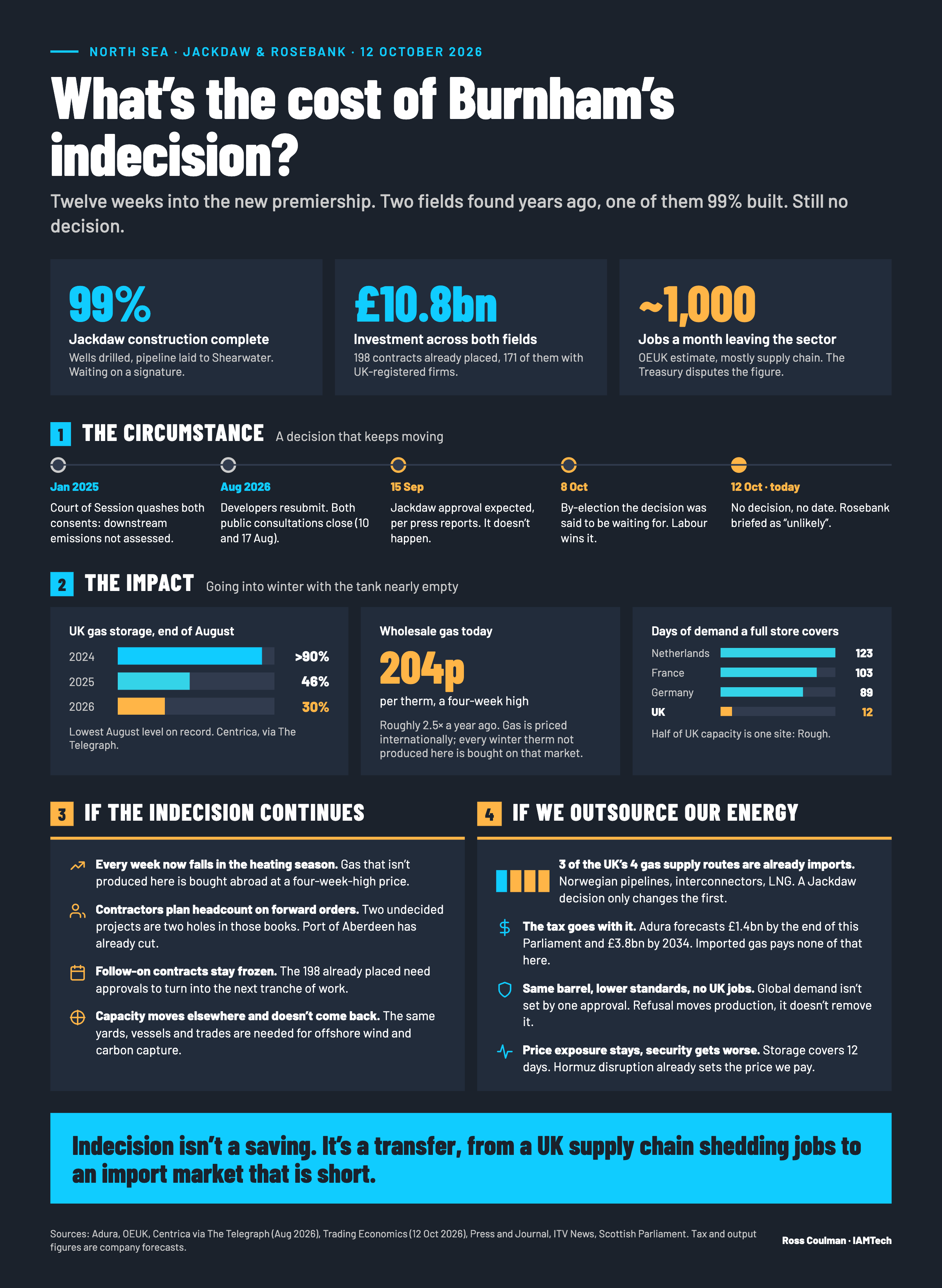
Meanwhile, UK gas storage was around 30% full at the end of August, against 46% at the same point in 2025 and more than 90% in 2024.
What the wait is costing, who stands to gain, who’s against it, and what to watch now.
The fields in question
Rosebank and Jackdaw aren’t new discoveries. Both had consent to develop until the Court of Session in Edinburgh ruled in January 2025 that the approvals were unlawful, after legal challenges from the campaign groups Uplift and Greenpeace.
The environmental assessments hadn’t considered the downstream emissions released when the oil and gas are eventually burned. The court didn’t decide whether either field should go ahead; it required the decisions to be taken again on that basis.
The developers resubmitted their environmental case, and both public consultations closed in August: Jackdaw’s on 10 August, Rosebank’s on 17 August. The decision sits with Energy Secretary Miatta Fahnbulleh, whom Burnham appointed on his first day in office, 20 July, with final consent then issued by the North Sea Transition Authority.
Both fields are operated by Adura, the Shell–Equinor joint venture. The two are at very different stages.
Jackdaw is a gas field around 250 km east of Aberdeen, developed as a tieback to the existing Shearwater hub. Adura says construction is 99% complete, with wells drilled and a pipeline laid to Shearwater, and puts peak output at around 40,000 barrels of oil equivalent a day, mostly gas. That is roughly 6% of projected UK North Sea gas production.
Rosebank, developed with Ithaca Energy west of Shetland, is the largest undeveloped oil field in the UK sector, with more than 300 million barrels of oil equivalent in recoverable resources. It is a phased subsea development producing to a redeployed floating production, storage and offloading vessel, the Petrojarl Rosebank, which arrived on location in June. Adura puts Rosebank at £8.7 billion of investment, and £10.8 billion across both fields.
Where the decision stands now
- Early September: the BBC and The Times reported that Jackdaw’s approval was imminent, with The Times naming 15 September and an announcement during a Burnham visit to Aberdeen. That was a reported expectation, not an official date.
- Mid-September: it didn’t happen. Press reports said the decision was being held until after the Holborn and St Pancras by-election on 8 October, triggered by Keir Starmer’s resignation of the seat, where Labour’s main challenger was the Greens. The government never confirmed that. The Conservatives accused it of putting party politics ahead of energy security.
- Rosebank: The Times reported government sources saying approval was very unlikely, with a decision to follow at a later date. A Labour source quoted by the Press and Journal on 10 October put it more bluntly: “I genuinely don’t know about Rosebank.”
- 30 September: MSPs rejected a Scottish Conservative motion backing both fields, passing a Labour amendment by 77 votes to 42 that said the decisions sit with the UK Energy Secretary through a quasi-judicial process. Holyrood couldn’t decide anything anyway, because licensing and consent are reserved to Westminster. What the vote did do was put Labour and SNP MSPs’ positions on the record: neither party would back the fields.
- 8 October: Labour held Holborn and St Pancras with a majority of 3,364 over the Greens. The stated reason for the delay has gone. Four days on, there is still no decision and no date. Industry sources told the Press and Journal that Jackdaw approval is expected “in the near future” and that the government wants to announce it in the Commons. On 11 October the Conservatives accused Burnham of “dithering and delaying”. The Department for Energy Security and Net Zero’s reply gave no date, only that any decision will consider “all relevant evidence”.
Who benefits
The most direct winners are the operators and their supply chains: engineering firms, fabrication yards, drilling contractors, and the catering and transport companies working the fields and the platforms that support them. OEUK, the industry body, puts the North Sea’s total footprint at around 200,000 jobs across the UK, most of them not on a platform but in the thousands of smaller firms that service one. Aberdeen and the North-East of Scotland carry most of that.
The Treasury benefits too, through tax on production. Adura forecasts £1.4 billion in tax from the two fields before the end of this Parliament, rising to £3.8 billion by 2034. Those are company forecasts: actual receipts depend on production, prices and whether the windfall tax regime changes alongside any “reset.”
What it means for the assets already in the water
Jackdaw isn’t a standalone platform. It ties back to the Shearwater hub, so its gas runs through processing and export infrastructure that is already operating. For the teams running that infrastructure, a tieback changes the maths on throughput, maintenance scope and how long the hub stays economic before decommissioning. Rosebank is a different profile again: a phased subsea development producing to a redeployed FPSO that is already on location. Either way, a consent decision isn’t the end of the engineering. It’s the start of commissioning, integration and handover, which is where planning, permits and readiness reviews do the work.
Local economies, and who’s losing right now
The case for local benefit is concrete, and it isn’t only a forecast. Adura says 198 contracts have already been placed across the two projects, 171 of them with UK-registered companies in North-east Scotland, Fife, the Highlands and north-east England.
The follow-on work depends on approvals that haven’t come, and for Rosebank now look less likely. The wait has a cost of its own. OEUK estimates the sector has been shedding close to 1,000 jobs a month, mostly in the supply chain (the Treasury disputes that figure). Port of Aberdeen has already confirmed cuts this year.
Those losses have several causes: a maturing basin, decommissioning, the tax regime and investment decisions. Delay on the two largest live projects adds to that pressure; it doesn’t explain all of it.
Less dependence on overseas, with a catch
This is where the two fields matter differently. Jackdaw is gas, and UK gas import dependency has climbed as domestic production has fallen: UK oil and gas output is down by roughly three-quarters from its late-1990s peak. Domestic gas displaces imported volumes, which is a genuine energy security argument.
The storage figures show how thin that margin already is. In late August, Centrica chief executive Chris O’Shea told The Telegraph the UK had “almost no gas in storage in the UK for the coming winter.” Storage sites were around 30% full that week, against 46% at the same point last year and more than 90% in each of the two years before. That was reportedly the lowest August level on record, after disruption in the Strait of Hormuz pushed European gas prices up. Today, 12 October, UK wholesale gas is trading at around 204p a therm, a four-week high and roughly two and a half times its level a year ago.
The UK also starts from a smaller tank than its neighbours. Completely full, UK storage covers around 12 days of average demand, against 89 in Germany, 103 in France and 123 in the Netherlands. Roughly half of that capacity is one facility, Centrica’s Rough field, and O’Shea wants government backing for a £2 billion redevelopment. The government’s answer was that supply is diverse: North Sea production, Norwegian pipelines, European interconnectors and three LNG terminals. Three of those four routes are imports, and a Jackdaw decision only changes the first.
Production and storage do different jobs. A producing field adds a steady domestic volume while it runs. Storage is the buffer that is injected in summer and drawn down in a cold snap. Jackdaw won’t refill storage, won’t add storage flexibility, and won’t lower prices on its own, because gas is priced internationally. Adura’s figure is around 6% of projected UK North Sea gas production, and around 10% of domestic production across both fields; campaigners put Jackdaw nearer 2% of total UK use once imports are counted. What it does change is how much of each winter’s gas has to be bought on a market that is currently short.
Rosebank is oil, and the case is weaker: a July 2026 parliamentary answer puts the share of UK-produced crude exported for refining abroad at 80–90%, so extra domestic production doesn’t translate into lower pump prices or meaningfully reduce the UK’s exposure to global oil prices. The Climate Change Committee has made the same point. “Less dependence on overseas” is a fair claim for gas. For oil, it’s a weaker one than the headlines suggest.
That export share is a legacy problem, not a policy choice. Much of the crude produced on the UK Continental Shelf doesn’t match the configuration and commercial requirements of the UK’s remaining refineries, and changing that would mean refinery investment for a basin in decline. Norway took a different route by keeping a direct stake in its own oil: the state owns 67% of Equinor and channels the proceeds into a sovereign wealth fund now worth more than $2 trillion. The UK sold its equivalent, Britoil, in the 1980s, and Treasury revenue from the North Sea goes into general spending, not a ring-fenced fund. There’s a sharp irony in that comparison: through Equinor’s half of Adura, part of Norway’s oil wealth will come from Rosebank and Jackdaw.
Who’s against it, and why
More than 1,900 trade unionists, including members of Unison, the NEU, the FBU and PCS, signed an open letter in May calling on the government to reject Rosebank outright. Their argument: its lifetime emissions would equal around 70% of the UK’s total annual output, incompatible with the UK’s climate commitments. Jackdaw is smaller but not small on this measure: Adura’s own estimate is 35.8 million tonnes of carbon over its 11-year life, equivalent to 90% of Scotland’s 2023 emissions. Friends of the Earth has said approving it would be a major step backwards. Greenpeace and Uplift, who won the original legal challenge, are expected to contest any fresh approval on the same grounds.
And the energy secretary holding the decision has her own history here. Before taking the role, Fahnbulleh ran a think tank focused on speeding up the shift away from fossil fuels, and has been publicly cautious about the pace of new licensing, even while saying oil and gas will remain “part of our energy mix for the foreseeable future.”
The case for saying yes
The case for approving both fields is narrower and stronger than the “reset” headlines suggest. Neither involves a new exploration licence, which the government has committed to ban through the Energy Independence Bill. Both are fields discovered years ago that went through years of environmental assessment. They lost consent because the assessment didn’t cover downstream emissions, not because either field was found unsafe or unnecessary. The developers have now supplied that assessment. Jackdaw is 99% built. Rosebank’s production vessel is already on location west of Shetland. Refusal wouldn’t recover any of that spending. It would put the committed investment at risk, cancel follow-on contracts and take specialist work out of a supply chain that is already shrinking.
The workforce argument matters as much as the investment figure. Supply chains take decades to build, and once fabrication yards close and crews move on, they don’t reassemble quickly. That includes the offshore wind and carbon capture projects the UK is counting on to hit net zero, which draw on many of the same vessels, ports and skilled trades as oil and gas. Contractors plan headcount against forward order books, and two undecided projects are two holes in those books. Every month they stay undecided, more of that capacity moves elsewhere, which makes the eventual transition harder to staff, not easier.
The emissions argument against Rosebank and Jackdaw is about where the barrel comes from, not whether it gets used. Global demand for oil and gas isn’t set by what one government approves. The case for saying yes is that extracting it under UK safety and environmental standards, with UK jobs and UK tax revenue attached, is a better outcome than importing the equivalent and losing all three.
Approving Rosebank and Jackdaw doesn’t reopen the North Sea. The commitment on new exploration licences stands either way. It closes out two fields that were already found, and in Jackdaw’s case already built, for a workforce that has been waiting since January 2025 for a decision on work it already knows how to do.
Why it matters, and when we’ll know
It’s a test of whether a government talking about a North Sea “reset” will approve fields its own energy secretary spent her pre-ministerial career arguing against, on a legal basis a Scottish court has already thrown out once. What to watch:
- Jackdaw: no official date. The by-election is over and the Commons is sitting. Industry briefing says approval is expected “in the near future” and that the government wants to announce it in the House. Until it does, the delay is a choice, not a calendar constraint.
- Jackdaw, if approved: 99% construction complete isn’t the same as ready to produce. Remaining mechanical completion, commissioning, pressure and leak testing, verification of safety-critical equipment, integration with Shearwater and final readiness reviews all sit between consent and first gas. Adura had been working to a start this winter; how much of that is still achievable depends on how much of the commissioning is already done. Expect a legal challenge to any fresh consent.
- Rosebank: no date. Current briefing points to refusal or further delay.
Every week of delay now falls in the heating season, with storage far below where it stood in previous years. An approval adds domestic gas to a market that is short of it, even if the first molecules arrive later than planned. A refusal or a further delay leaves the contractors already cutting staff with less forward work to plan against. That is the cost of indecision. It isn’t a saving. It is a transfer, from a domestic supply chain that is shedding jobs to an import market that is currently short.
About the Author: Ross Coulman is the Managing Director of IAMTech, a global leader in industrial asset management and technology solutions. With over 30 years of experience in the sector, Ross has driven IAMTech’s growth from a start-up to a trusted partner for the oil, gas, chemical, and power industries worldwide. Passionate about innovation and sustainability, he champions the use of digital transformation to enhance efficiency, safety, and compliance across complex industrial operations