
























The emergency responders who have run towards fires at energy facilities across the Middle East over the past weeks deserve enormous credit. They have done so under conditions that no emergency response plan was ever designed to anticipate — simultaneous ignitions across wide areas, intercept debris landing unpredictably across complex sites, degraded communications, and the psychological weight of knowing that further strikes could come at any moment.
This article is not a critique of anyone who has fought those fires. It is written in professional solidarity with them — and with the HSE directors, safety managers, and emergency planning teams who are right now looking at what the industry faces and asking: what can we do better, before the next one?
That question has a well-established engineering answer. And the time to act on it is now, while there is no fire burning.
The Challenge the Industry Has Never Faced at This Scale
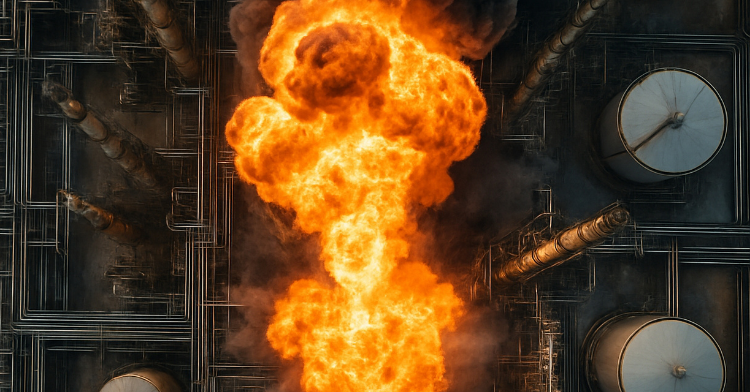
Most industrial fire response plans at petrochemical and refining facilities in the Middle East were designed around a single initiating event — one leak, one ignition source, one tank. The threat model has changed. Air defence intercepts, while operationally successful in preventing direct impacts, can scatter burning debris across wide areas simultaneously. A single intercept event can produce multiple ignition points across a complex, each requiring immediate resource allocation.
This is genuinely new territory. And it exposes a pre-planning gap that the industry — not just in the Middle East, but globally — now has a compelling reason to close.
What Fire Engineering Tells Us About Resource Sufficiency
The core principle is this: the outcome of a tank fire is determined largely before the fire starts, by whether the facility has calculated what it needs and confirmed it has enough.
NFPA 11, the international standard governing firefighting foam systems, establishes minimum requirements that are not aspirational — they are the engineering threshold below which foam suppression of a full-surface petroleum tank fire is unlikely to succeed. For a crude oil storage tank, that means a minimum foam solution application rate of 4.1 L/min/m² sustained for at least 55 minutes, applied continuously without interruption.
The arithmetic for a large storage tank is significant. A 75-metre diameter tank has a surface area of approximately 4,400 m². At the NFPA 11 minimum rate, that demands around 18,000 litres of foam solution per minute — sustained for 55 minutes. The total foam concentrate required, before accounting for simultaneous tank cooling and any additional exposure protection, runs to many thousands of litres of concentrate.
That calculation has to be done in advance. It cannot be done reliably at 2 a.m. with a fire burning and multiple radio channels active. |
Three Strategic Postures — and Why Knowing Which to Apply Matters
Fire engineering for petroleum facilities recognises three distinct strategic postures, and the decision between them must be pre-planned:
Offensive — active foam suppression to extinguish the fire. This is only viable when confirmed foam inventory meets NFPA 11 minimum discharge requirements, water supply can sustain the required flow rate for the full duration, application equipment is in position and operational, and sufficient trained personnel can execute without interruption. All four conditions must hold.
Defensive — protecting exposures rather than attacking the primary fire. Cooling adjacent tanks, protecting interconnecting pipework, maintaining bund integrity, and preventing fire spread while the primary fire burns in a controlled manner. This is not a fallback position. In many scenarios — particularly multi-ignition events where resources must be allocated across multiple simultaneous priorities — it is the correct and professional response.
Passive — withdrawal to a safe perimeter. Reserved for scenarios where neither offensive nor defensive operations can be safely sustained.
The principle enshrined in fire engineering guidance is clear: if available resources do not meet the threshold for a viable offensive attack, the correct posture is defensive. An incomplete foam attack — one that runs out of concentrate before achieving full surface coverage and the minimum discharge time — does not achieve a partial suppression. It depletes the one resource that cannot be quickly replenished, potentially disturbs the burning liquid surface, and leaves the fire continuing with nothing left in reserve.
This is counter-intuitive under duress. It takes genuine professional discipline, and a pre-agreed plan, to make that call correctly in the moment.
The Particular Arithmetic of Multiple Simultaneous Ignitions
When intercept debris creates several ignition points simultaneously across a complex, the foam and water demand calculation changes fundamentally. Resources that would have been adequate for a single-tank offensive attack may be sufficient only for a defensive posture across multiple exposures. Pre-planning for this scenario means deciding in advance — not in the moment — which assets receive offensive foam attack, which receive defensive cooling water, and which must, if necessary, be allowed to burn out in a controlled manner while higher-consequence assets are protected.
That hierarchy of asset protection — ranked by consequence, by proximity, by interconnection risk — is something that can only be determined rationally before an incident. Under the stress of a live multi-ignition event, it is extraordinarily difficult to make those triage decisions without a pre-agreed framework to anchor them.
What Good Pre-Incident Planning Looks Like
For facilities operating under an elevated threat environment, the following should be considered non-negotiable:
▸ Foam inventory audit — What concentrate is available on-site, by type and condition? What is the realistic resupply timeline given current regional logistics? Does the inventory cover the NFPA 11 minimum discharge requirement for the highest-consequence credible scenario?
▸ Worst-case foam demand calculations — Run the numbers for the three most consequential fire scenarios at your facility. If your inventory falls short, that is something to know now.
▸ Multi-ignition response protocols — Define your pre-agreed defensive posture for simultaneous ignitions at two or more locations. Which assets are protected offensively, which defensively, and in what priority order?
▸ Firewater system audit — Flow rate, pump capacity, ring main vulnerability, backup supply. What happens to your firewater system if a strike damages the pump house?
▸ Mutual aid pre-agreements — Who can deliver additional foam concentrate to your facility, from where, in what timeframe? Are those agreements active and tested?
▸ Incident command exercises — Has your incident commander run a tabletop exercise against a multi-ignition scenario? Do they know your resource numbers without looking them up?
These are not extraordinary measures. They are the established requirements of API RP 2001 and NFPA 11 pre-incident planning guidance. The current environment makes acting on them urgent.
The Window Is Now
Every emergency response plan should be built, stress-tested, and internalised during the periods when it is not needed — so that when it is needed, the decisions have already been made, and the commander is executing a plan rather than improvising one.
The energy facilities of the Middle East are operated by teams of extraordinary skill and dedication, protecting infrastructure that matters to the entire world. The professional question for those teams right now is not whether they have done well under impossible circumstances — they have. It is whether there is more that engineering, calculation, and structured pre-planning can give them before the next event.
We believe there is. In a follow-up piece next week, we will be sharing an initiative with our partners that we hope can contribute practically to that effort across the region.
Run the calculations. Audit the foam. Define the defensive posture before you need it. The planning window is open. |
About the Author: Ross Coulman is the Managing Director of IAMTech, a global leader in industrial asset management and technology solutions. With over 20 years of experience in the sector, Ross has driven IAMTech’s growth from a start-up to a trusted partner for the oil, gas, chemical, and power industries worldwide. Passionate about innovation and sustainability, he champions the use of digital transformation to enhance efficiency, safety, and compliance across complex industrial operations.
References & Standards
• NFPA 11: Standard for Low-, Medium-, and High-Expansion Foam — application rates and minimum discharge times for petroleum storage tank fires
• API RP 2001 (10th Edition, Addendum 1): Fire Protection in Refineries — pre-incident planning and emergency action plan requirements
• Risk-Based Fire Protection Strategy in Crude Oil Storage Facilities, International Fire Protection Magazine
• Use of Foam for Firefighting in Tank Farms of the Oil and Petrochemical Industry, Parts 1 & 2, Asia Pacific Fire / International Fire Protection Magazine
• Storage Tank Fires: Is Your Department Prepared?, Fire Engineering (Craig H. Shelley)