
























Turn on any financial news channel this week and you will hear the same reference point: this is the worst energy crisis since 1973. It is repeated with confidence, and it is wrong.
The 1973 Arab Oil Embargo removed five million barrels per day from global supply — approximately five per cent of what the world was consuming. It quadrupled the price of oil, tipped the United States into its deepest recession since the Great Depression, and contracted UK GDP by nearly four per cent. The 1979 Iranian Revolution took a further 5.6 million barrels per day. Between them, those two shocks reshaped the global economic order and remain the defining energy catastrophe of the modern era.
The current disruption has removed more than ten million barrels per day — confirmed by the IEA as the largest supply shock in the recorded history of the global oil market. We are not in 1973. We are not in 1979. We are somewhere the world has not been before, and the gap between what those crises caused and what this one will cause is not yet widely understood.
Consider what it means for 12 to 13 per cent of the world’s energy supply to disappear — not to be embargoed, not to be rerouted, but to be physically destroyed, with rebuild timelines measured in years.
Consider it not just at the fuel pump, but across the full chain of dependency that the modern world has built on energy: the natural gas that produces the nitrogen fertiliser that grows the food that feeds half the global population. The diesel that moves that food from farm to port to supermarket. The power that keeps the cold chain intact between harvest and plate.
That is the question this article asks. The data beneath it is more serious than most of the commentary currently suggests.
What 1973 Actually Was
In October 1973, Arab members of OPEC cut production by approximately five million barrels per day — roughly five per cent of global supply at the time. That reduction was enough to quadruple the price of oil within months, push the United States into its worst recession since the Great Depression, and contract UK GDP by nearly four per cent over two years. Unemployment in the United States climbed from 4.6 per cent to nine per cent. It took fourteen quarters for the British economy to return to where it had been when the embargo began.
Five million barrels per day caused all of that.
The 1979 Iranian Revolution removed approximately 5.6 million barrels per day. Combined with the tail of 1973, the two shocks across that decade produced stagflation, double-digit interest rates, and a generational restructuring of how the world thought about energy security.
Both crises were severe. Both left lasting marks on the global economy. And both were smaller — significantly smaller, less than half — than what the IEA has now confirmed is missing from global supply.
The Crisis That Goes Far Beyond the Fuel Pump
The oil price is visible. What flows from it is less so — and it is there that the true weight of this disruption becomes clear.
Qatar’s Ras Laffan complex, which represents approximately seventeen per cent of global LNG supply, is offline. That matters for power generation and heating, but it matters even more for something less immediately obvious: nitrogen fertiliser. Natural gas is the primary feedstock for urea, the world’s most widely used fertiliser. When LNG becomes scarce and expensive, the fertiliser that grows food for half the world’s population becomes scarce and expensive in turn.
Urea prices are projected to rise sixty per cent in 2026. Global fertiliser prices are forecast to average fifteen to twenty per cent higher across the first half of this year. With less fertiliser reaching farms, yields fall. With higher energy costs, the diesel that moves harvests from field to storage, and from storage to port, becomes harder to afford at every point in the chain. The refrigerated containers and cold-storage facilities that prevent spoilage between farm and consumer run on electricity that is itself under price pressure across every importing nation.
Energy is not just what moves food. It is what produces it. That link — from gas field to nitrogen plant to farm to table — is one of the most consequential and least-discussed chains of dependency in the global economy. It is now under severe strain.
Beyond food: industrial production across energy-intensive sectors — aluminium, steel, cement, chemicals, pharmaceuticals — is being curtailed or relocated. Plants that reduce output or shut down take months to restart. Supply chains disrupted at this scale take years to fully rebuild.
Why This Disruption Is Structurally Different
Every previous energy shock of the modern era was ultimately a temporary one. Embargoes ended. Revolutions stabilised. Supply returned, and recovery — painful as it was — was a matter of time.
What is different now is the physical destruction of productive capacity. Please remember, destruction is not just occurring in the Middle East.
The Tuapse oil refinery and export terminal on the Black Sea — 240,000 barrels per day of Russian processing and export capacity — has been struck four times in sixteen days. An environmental disaster has been declared. Rebuild timelines are estimated at eighteen to twenty-four months at minimum. The Ras Laffan LNG infrastructure, the refineries and storage terminals across the Gulf that have been targeted throughout this conflict, represent decades of engineering and capital investment that cannot be replaced on any near-term horizon.
Rystad Energy estimates that $58 billion of energy infrastructure has been damaged to date. That figure will be revised upward.
The world is not waiting for an embargo to lift. It is absorbing the permanent loss of productive capacity that will take years to rebuild.
What This Means for Global Society
Fuel: who runs short first
The countries most acutely exposed to the direct fuel supply shock are those with the highest dependence on Middle East imports and the smallest strategic reserves. In Asia, Japan, South Korea, and India source the large majority of their crude from Gulf producers. Bangladesh — which relies on imports for approximately 95 per cent of its total energy needs — has already implemented emergency rationing: offices, markets and shopping centres are closing at 6 p.m. to reduce electricity consumption. Myanmar, Sri Lanka, and Pakistan face comparable constraints with far less economic capacity to absorb the pressure.
In Europe, the fuel shock has arrived through a less obvious but equally significant channel. The Middle East refineries that previously supplied approximately 75 per cent of Europe’s jet fuel are now effectively offline. The consequence is not a crude oil shortage but the depletion of a refined product with no rapid domestic replacement, and flight cancellations across European hubs are already a visible result.
Sub-Saharan Africa faces the broadest exposure. Nations that import virtually all their refined products are competing for a significantly reduced global supply at prices that have risen more than fifty per cent. Households and businesses unable to afford market-rate fuel are reverting to charcoal and wood — a regression with its own compounding consequences for deforestation, air quality, and health.
Heating: winter 2026
The heating dimension is most acute in Europe. Gas — much of it arriving as LNG, with Qatar’s Ras Laffan complex representing seventeen per cent of global supply now offline — is the primary source of home heating across the UK, Germany, France, Italy, the Netherlands, and much of Eastern Europe. European gas storage is typically replenished over summer from LNG imports. With Ras Laffan offline, the ability to fill storage before winter 2026 is severely constrained, and governments are beginning to plan for a winter with significantly less buffer than any since the 2022 gas crisis.
The UK has been specifically identified by multiple current assessments as the most severely exposed major economy — a combination of high gas dependency, limited domestic storage capacity, and an economic baseline already under strain.
Germany and Italy have been forecast by the European Central Bank to enter a technical recession before the year is out. In South and East Asia, South Korea and Japan face acute LNG exposure for power generation and domestic heating.
Pakistan and Bangladesh, which use LNG for domestic cooking gas at scale, are already seeing households shift toward alternative fuels with serious implications for health.
Food and fertiliser: the regions most at risk
The food and fertiliser cascade is where the consequences of this disruption will be felt most severely and most durably. The World Food Programme has warned that 45 million additional people could fall into acute food insecurity if oil prices remain above $100 per barrel through the planting season. That threshold has already been passed.
The regional distribution of that risk is stark. The WFP projects a 21 per cent increase in food-insecure populations across West and Central Africa, and 17 per cent across East and Southern Africa. In absolute terms: more than 87 million people are already facing hunger in East and Southern Africa; 52 million are projected to be acutely food insecure in West and Central Africa by mid-2026. These are regions where food systems were already stretched to their limit, where smallholder farmers had minimal access to fertiliser even at pre-crisis prices, and where the margin between subsistence and crisis is measured in a single harvest.
In South Asia, where nearly two billion people depend on food systems heavily reliant on urea and diesel, a 24 per cent increase in food insecurity is forecast. India imports significant quantities of urea. Pakistan’s agricultural sector faces a combination of sharply higher input costs and reduced export capacity that presents a genuine risk of both food crisis and economic collapse.
The longer-term consequence that receives the least attention is the fertiliser gap itself. When farmers cannot afford fertiliser during this planting season, the yield reduction does not manifest until harvest. The food crisis of late 2026 and into 2027 will partly reflect decisions being made right now — in fields where urea that cost one price six months ago now costs sixty per cent more, or cannot be sourced at all.
This is why 1973 and 1979 are inadequate reference points — not just because the volume of missing supply is twice as large, but because the world that is missing it is categorically more complex, more interconnected, and more dependent on energy at every level of its function. In 1973, an oil shock produced a recession.
In 2026, an oil shock of twice the magnitude runs through fertiliser into food, through LNG into winter heating, through jet fuel into supply chains, through diesel into the trucks and ships that move everything. The people most affected are not sitting in petrol queues in suburban America. They are smallholder farmers in the Sahel, families in Dhaka rationing electricity, children in East Africa whose next meal depends on a harvest shaped by fertiliser costs set thousands of miles away.
The world has not been here before. The data confirms it. And the consequences, when mapped onto actual human lives rather than economic indices, are more serious than any comparison to 1973 begins to suggest.
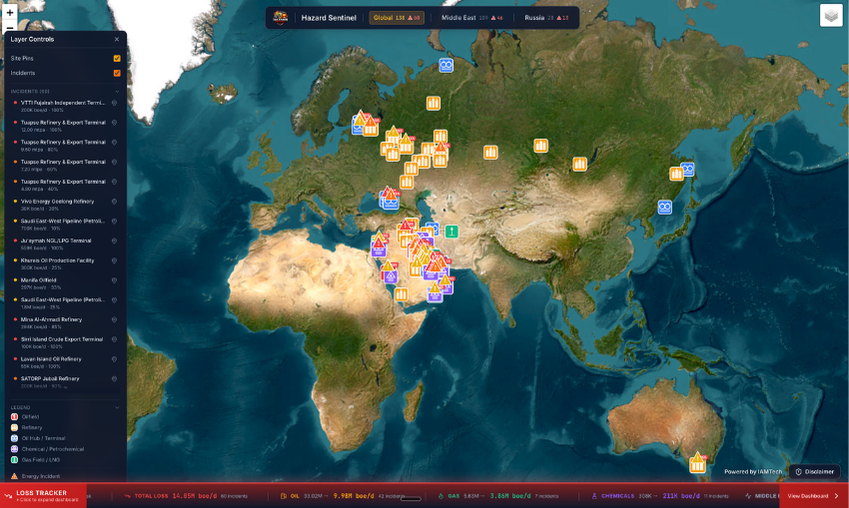
To stay informed, track live production losses, industrial incidents, and hazard assessments across the GCC and Iran in real-time using the Hazard Sentinel Public Map - Click here.
About the Author: Ross Coulman is the Managing Director of IAMTech, a global leader in industrial asset management and technology solutions. With over 20 years of experience in the sector, Ross has driven IAMTech’s growth from a start-up to a trusted partner for the oil, gas, chemical, and power industries worldwide. Passionate about innovation and sustainability, he champions the use of digital transformation to enhance efficiency, safety, and compliance across complex industrial operations.
Sources & References
• International Energy Agency, Oil Market Report, April 2026
• IEA, 2026 Energy Crisis Policy Response Tracker
• International Monetary Fund, World Economic Outlook Update, 2026
• UN News: Middle East war shockwaves ripple through Asia-Pacific, March 2026
• World Food Programme: Food insecurity could reach record levels, 2026
• UNDP: The Impacts of the Middle East Conflict on Africa, 2026
• UN News: Energy crunch hits vulnerable nations, April 2026
• FAO: Chief Economist warns of severe global food security risks, 2026
• Euronews: Fertiliser crisis caused by Iran war sparks global food security fears, 1 May 2026
• World Bank, Commodity Markets Outlook, April 2026
• Rystad Energy, Energy Infrastructure Damage Assessment, 2026